
The questions we answer on almost every doorstep
Grouped by subject and answered the way our surveyors answer them in person — without the sales language and without pretending every wet wall is rising damp.
Covering Dorset · Hampshire · Wiltshire
Ask us directly
1/3Takes under a minute. A qualified surveyor attends — never a salesperson.
No obligation, no sales visit. Your details are used only to arrange the survey.
Surveys and diagnosis
What happens before anyone quotes.
Yes. The survey visit and the written report that follows it are complimentary, and there is no obligation to proceed. We would rather issue a report that tells you nothing needs doing than sell you work you do not need.
Most surveys are booked within a few working days. Where there is an active leak, spreading mould in an occupied bedroom or a tenant health concern, we prioritise the visit.
Probably not. Genuine rising damp is far less common than the number of injection quotations issued each year suggests. Bridged damp-proof courses, penetrating damp and condensation account for the majority of what we survey — and all three have different, usually cheaper, remedies.
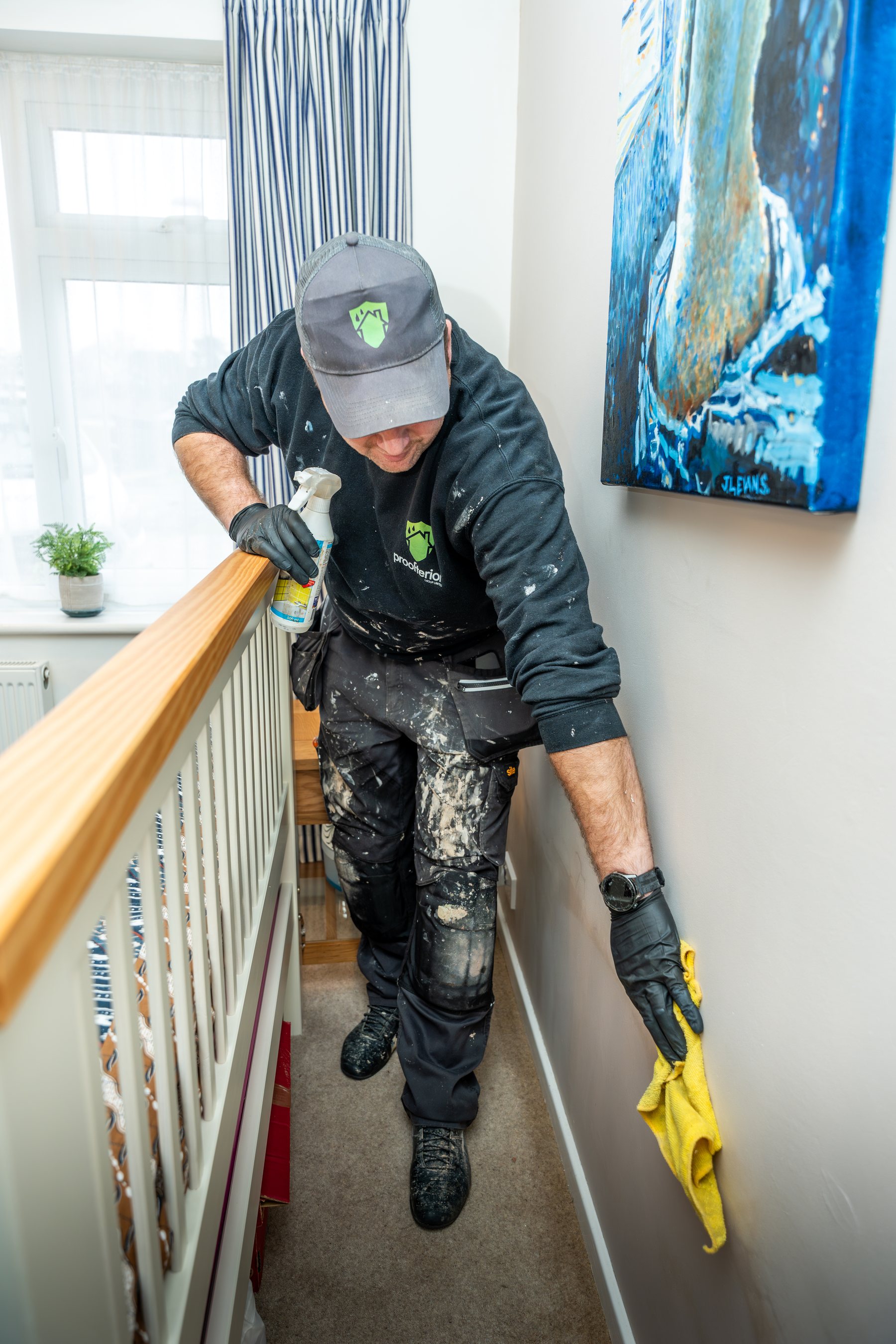
Hacking off plaster is dusty work, so we sheet up, run extraction, and clean down at the end of every day. Our site supervisor photographs the condition of the room daily so nothing is disputed later.
It covers our workmanship and the specified damp-proofing system on the areas we treated. It is insured, so it stands independently of the company, and it is issued in writing on completion alongside your photographic handover pack.
Yes. Our surveyors regularly produce reports used for mortgage retentions, sale negotiations, landlord disrepair matters and Awaab’s Law compliance. The report sets out findings, readings, cause and specification.
Damp proofing
Rising damp, penetrating damp and damp-proof courses.
Often not. A large share of the walls we survey are wet for a reason that injection would not touch — a bridged DPC, a leaking gully, a failed lead flashing or condensation. We only specify injection where readings and salt profile genuinely indicate rising moisture.
A single wall in an average terraced or semi-detached home is usually two to three days including replastering. Whole-property work runs to one or two weeks. We give you a working programme with the quotation.
New render needs time to cure and release construction moisture. Allow roughly a week per 5mm of thickness before using a mist coat of breathable emulsion, and avoid vinyl papers or oil-based paint for the first few months.
Yes. The 25-year workmanship guarantee is registered against the property, so it passes to a buyer and can be produced for a mortgage valuer or solicitor.
Rising damp is worst at the base of the wall and shows salt contamination. Condensation is worst on cold surfaces, in corners and behind furniture, and tends to appear as surface mould rather than a salt band. The two frequently occur together.
No. Masonry releases construction and residual moisture slowly — roughly a month per 25mm of wall thickness. The replaster system is designed so the room is usable and decoratable long before the wall is fully dry.
They come off to reach the base of the wall. Original mouldings are eased off carefully and refitted where sound; decayed timber is replaced in matching profile.
Condensation and mould
The most commonly misdiagnosed cause of a wet wall.
Rarely entirely. Occupancy adds moisture, but a property that cannot ventilate or that has significant cold bridging will condense regardless of how it is used. Our report distinguishes the two honestly, which matters if a landlord and tenant disagree.
In a house with a loft and a reasonably open hallway, yes — it dilutes moist air continuously rather than removing it in bursts. In flats without a loft void we use decentralised continuous extract instead.
Insulating without ventilating often makes condensation worse by making the building tighter. The two have to be specified together.
Bleach removes the colour and leaves the hyphae and the moisture behind, so the growth returns. It also adds water to the surface. A biocidal treatment applied after the source is fixed is the only durable route.
We arrange air and surface sampling where a health or legal question needs answering. For the majority of domestic cases the species does not change the remediation.
Where a vulnerable occupant is affected we prioritise the survey — usually within a few working days across our coverage area.
Timber, rot and woodworm
Structural decay and infestation.
More urgent than wet rot. Dry rot can travel through masonry and behind plaster to find new timber, so a small visible outbreak may already have colonised joists in the next room. It should be investigated promptly.
No. We lift enough boards to establish extent and reach the affected members, and we relay them. Full relaying is only specified where the decking itself has gone.
Not always. Where the moisture source is removed and the decay is wet rot, replacement plus drying may be sufficient. Dry rot and active woodworm normally do require treatment.
Untreated, yes. Its ability to spread through inert material means it can compromise structural timber some distance from the original wet area. Caught early and dried out, it is entirely manageable.
Only if water returns. Where our works include removal of the moisture source, recurrence is very rare and covered by the guarantee.
Some, yes — enough to see where the strands have travelled. We keep opening up as tight as the evidence allows and reinstate everything we remove.
Basements and waterproofing
Below-ground and habitable conversions.
Tanking is simpler and cheaper but relies on a sound, stable structure and can be defeated by high pressure. Membranes work with the water instead of against it and are the safer choice for habitable conversions. We recommend based on the structure, not on preference.
If the system channels water rather than resisting it, yes — and for a habitable basement we specify twin pumps with a battery backup and alarm.
Yes, subject to means of escape, headroom and ventilation requirements. We will flag anything that needs building control involvement early.
Find out what is actually wrong with the wall
A qualified surveyor attends, tests properly and writes it down. No obligation, no sales visit, no charge.
Dorset · Hampshire · Wiltshire